Nepal, Kathmandu 1 (Celebrating Festivals)
November 6, 2010 – continued
As I lay there resting, it suddenly struck me that Kathmandu wasn’t new to me at all. The city first entered my head about 20 years ago – thanks to the absolutely brilliant adventure game that was my favourite back then, “Zak McKracken”! I still love thinking back to that computer game, which was bursting with wit and hilarious puzzles. Would Kathmandu, 20 years on, still look the way it did in the game?
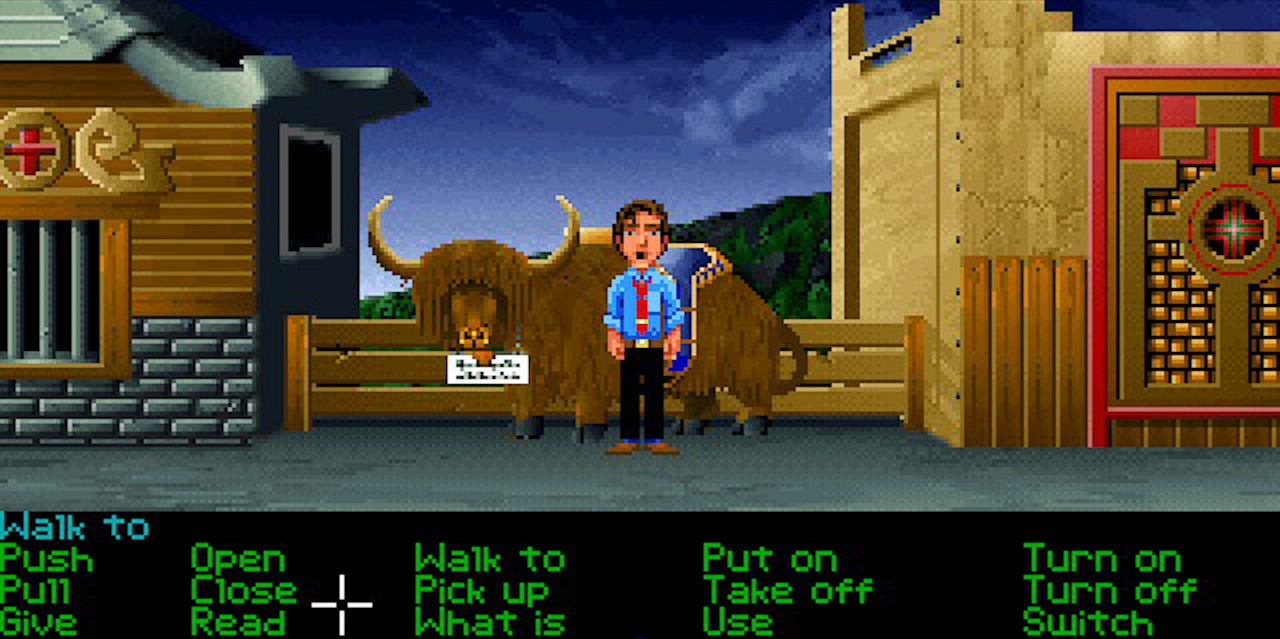
…with straw by the roadside, cud-chewing yaks and enlightened gurus?
Sadly not. Kathmandu had obviously moved with the times in the meantime. Still curious about the city, I headed out into the hustle and bustle. As luck would have it, I ran into Thijs, a Dutch guy I’d already met on the way to Mt. Everest Base Camp. Weighed down with his luggage, he’d been searching for a vacant room for quite a while – yep, I knew that drama only too well. I offered him the second bed in my double room, and he gratefully accepted. Together we then explored the tourist strip of Thamel…
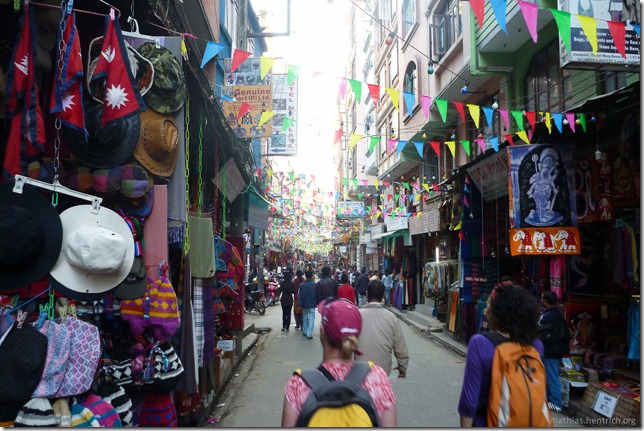
…and, besides the colourfully decorated streets and stalls, saw crowds of people, especially tourists. Quite a contrast to the almost deserted Tibet just a few days earlier.
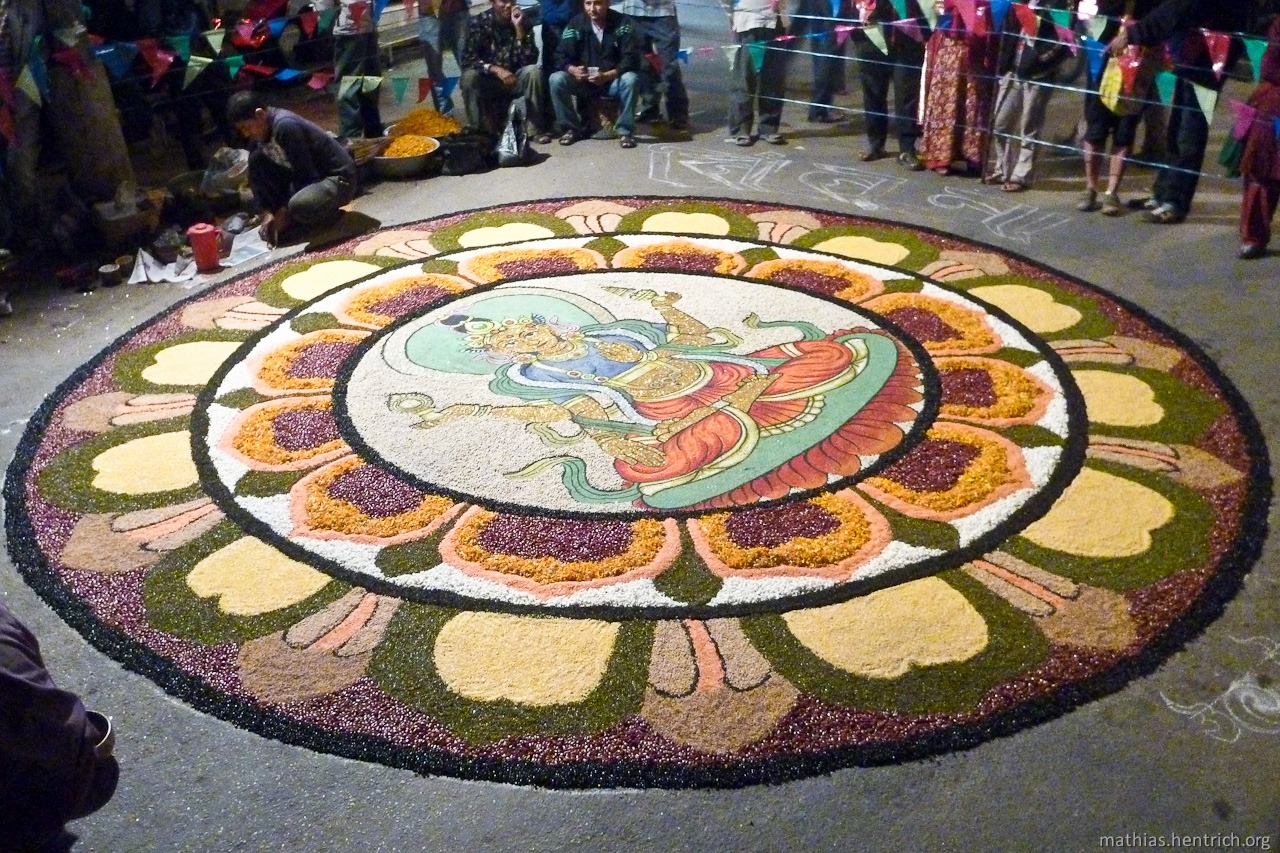
Street artists conjured up impressive pictures on the asphalt. What’s truly remarkable about this piece: it took days of work and was made of nothing but coloured flour, rice, beans and petals.
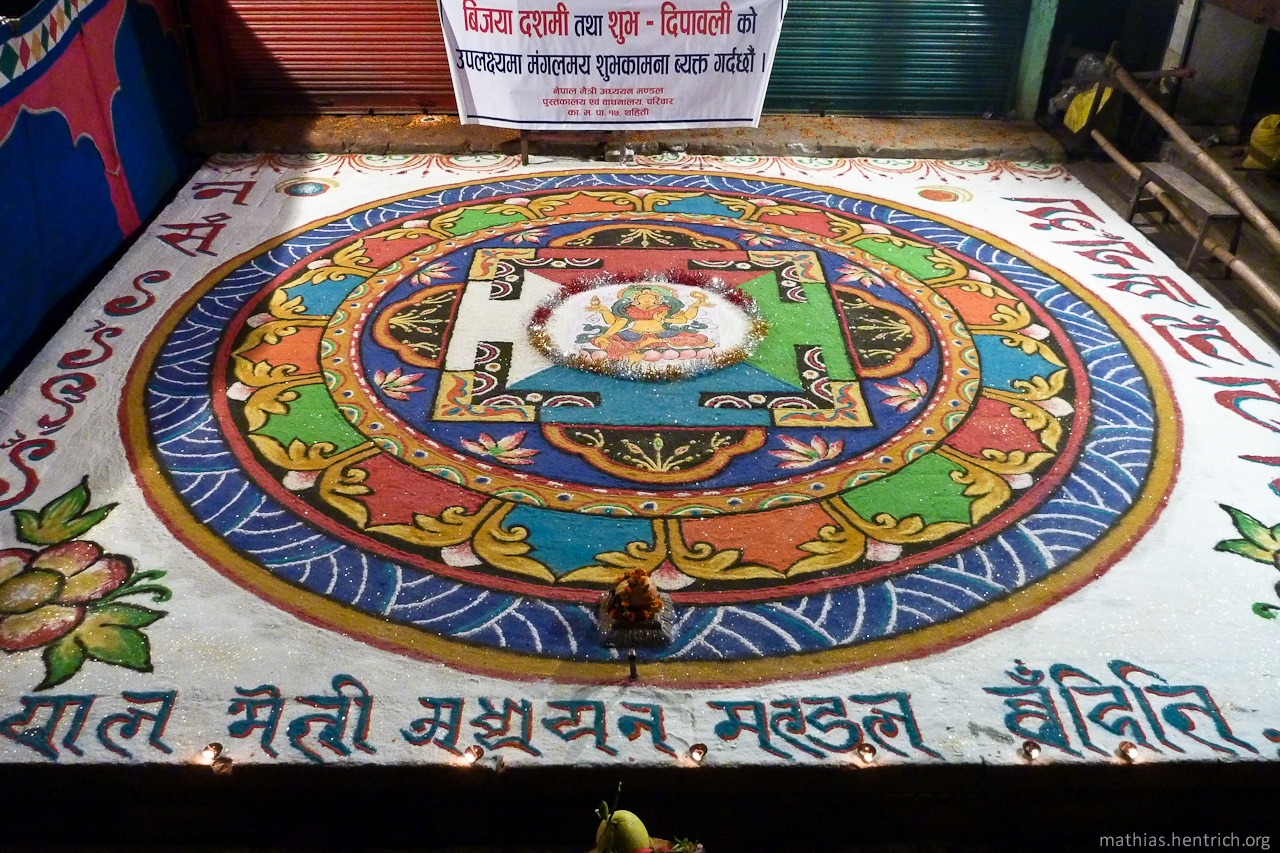
This piece, too, was created at the side of a street with great attention to detail and simple “ingredients”. They were even kind enough to provide ladder-like contraptions so you could get the best possible shot of it.
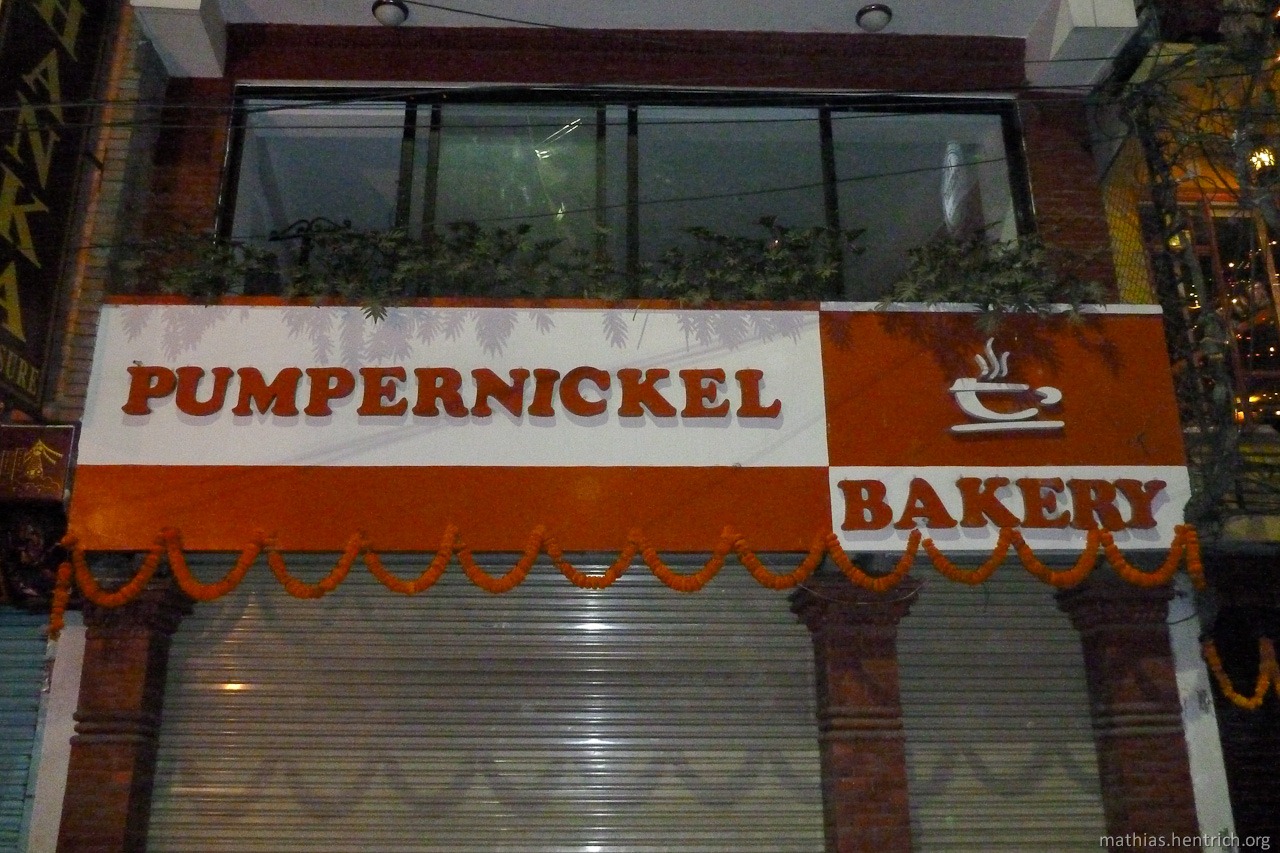
While exploring the city we of course came across the obligatory German bakery, which apparently every big Asian city seems to have.
November 7, 2010
The next day was all about the Newar New Year.
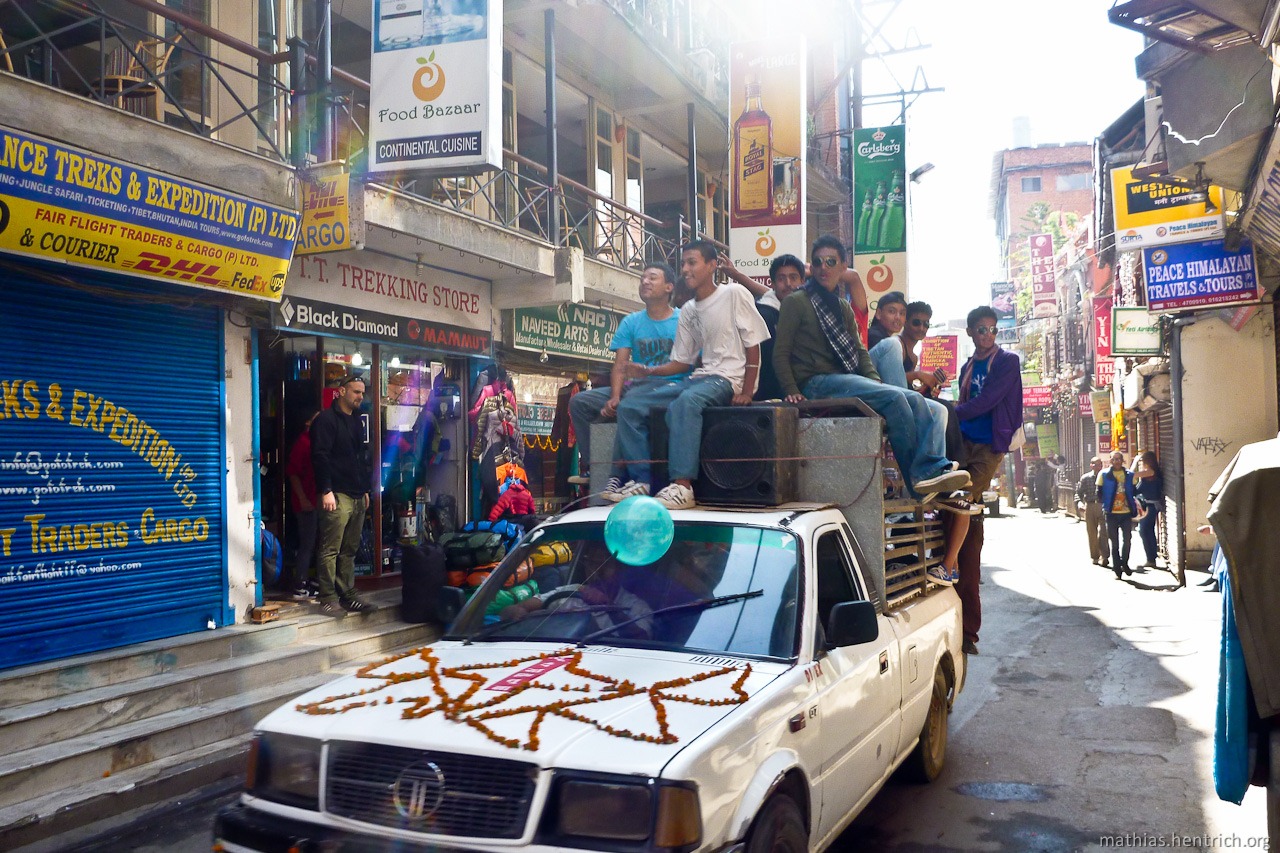
During the day, “pimped” cars full of partying teenagers cruised the streets with their music blaring…
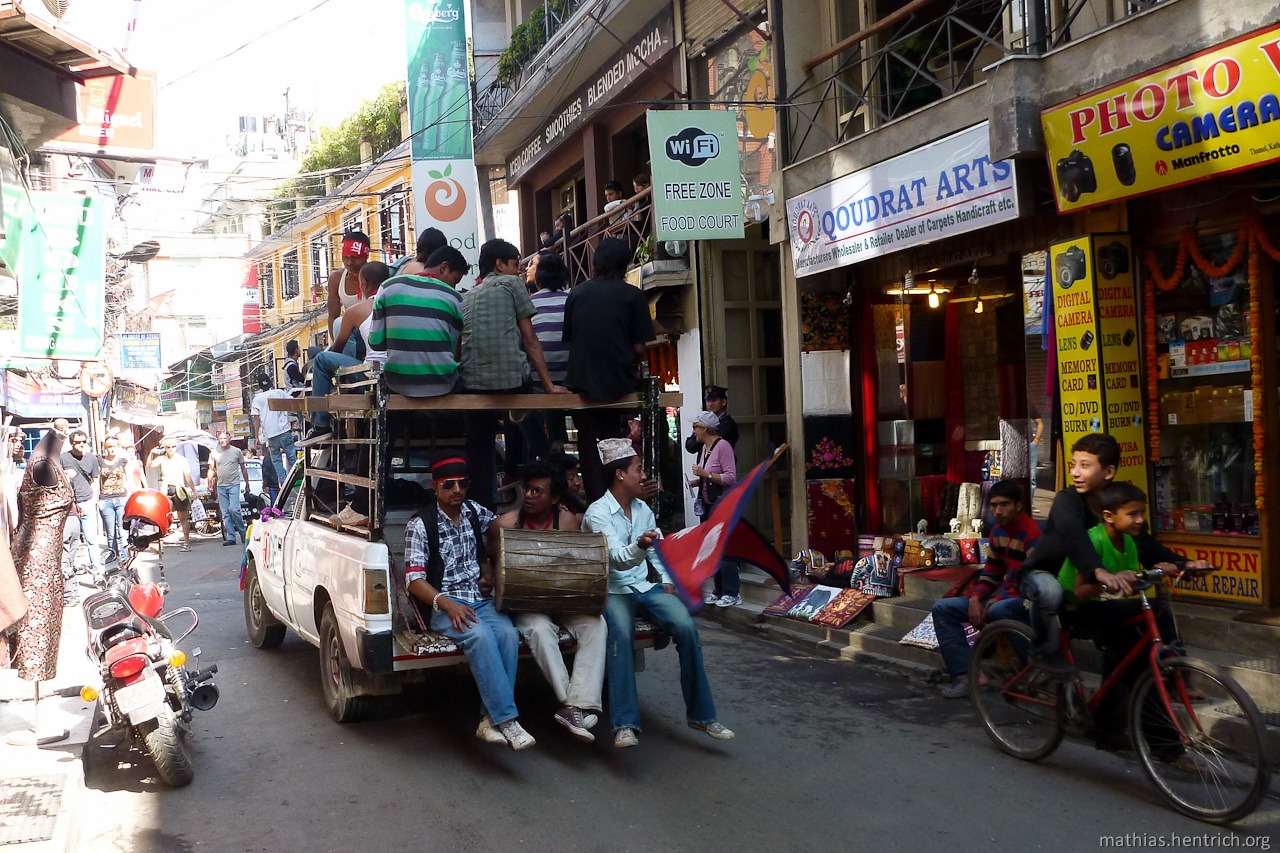
…and got the party going.

In the evening the city was brightly lit and New Year’s rockets were shooting into the sky. Thijs, Patrick and I explored Kathmandu’s New Year celebrations by night, wandering curiously through the alleys.
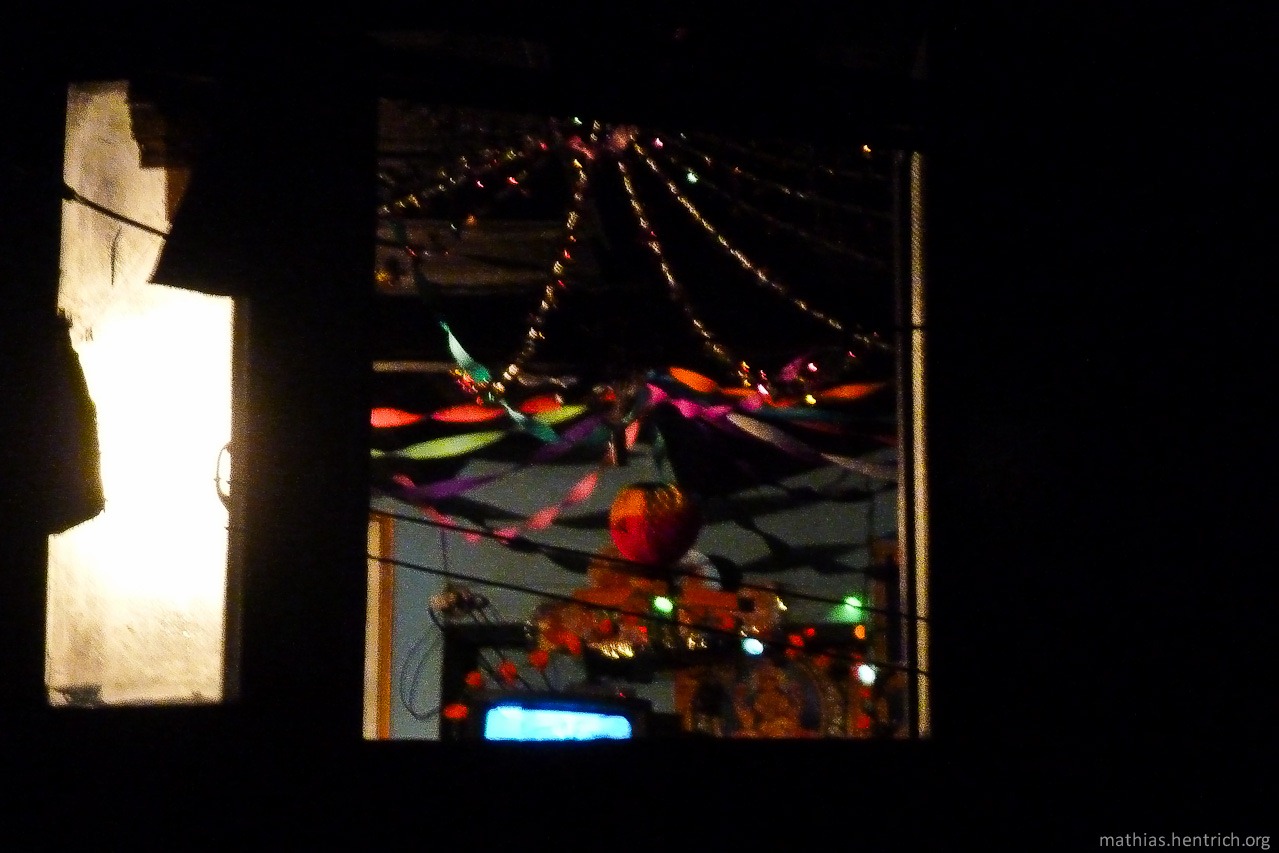
Families had gathered and homes were festively decorated. Suddenly a rather unusual sight caught our eye:
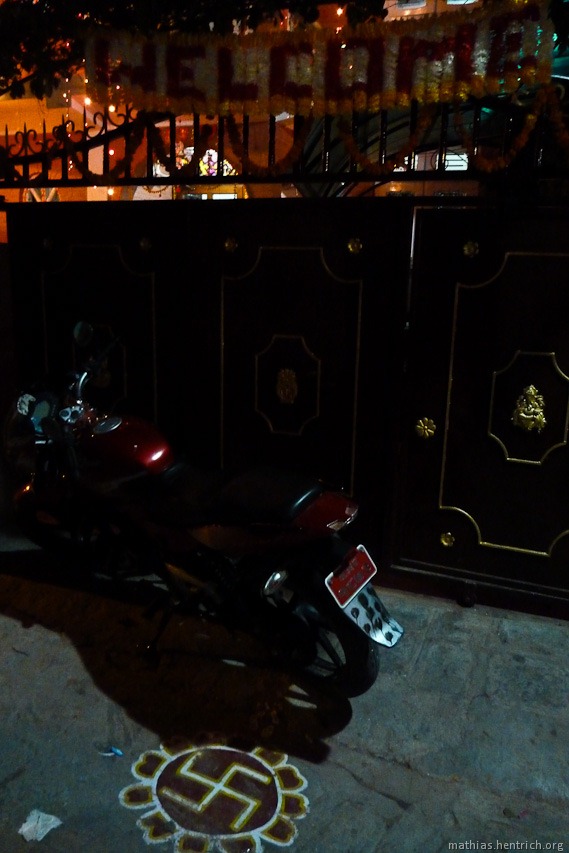
A luxurious house with “Welcome” above the front door and a familiar symbol in front of it. If you’re recoiling right now: stop! Please read this compulsory article first: Swastika. In my view, history teaching in German schools is generally poor. I went to five different schools and still had to find out for myself about the many other meanings of this historic, roughly 6000-year-old symbol. I first saw it in Mongolia as an ornament on doors and chairs, then in Tibet as ornamentation and decoration in many monasteries, and in Nepal mainly as a good-luck charm on trucks or as decoration by the entrance, along the lines of “Step inside and bring good luck inside.” In large parts of Asia this symbol has absolutely nothing to do with World War II.
Oh well, if I got started on the subject of school now… Should I, shouldn’t I…? Maybe just very briefly, or I’ll get far too worked up. Who hasn’t heard the line “The youth of today…” (supposedly from Socrates, though there’s no proof whatsoever)? There’s little doubt that for centuries the parents‘ generation has been moaning about the next one. Whether rightly or wrongly is a matter of opinion, and I’ll leave that open. The one fact – and this has been proven several times over – is that the German education system is going downhill. Let’s start with the universities: I saw the funding cuts first-hand during my eight years at university. I was on the student council, on several faculty committees, the examination board, the faculty board etc., so I got to see the students‘ problems up close and also got a look behind the scenes of university self-government. For one thing, not everyone has the money – and luckily very few have the criminal energy of a certain lying baron – to get hold of their academic titles in dubious ways. For the honest ones, it means learning, drawing conclusions and developing under ever tougher conditions. Among the broad mass of students, demotivation is on the rise. The annoying part is that a large share of these very students go on to become the teachers who will one day teach our own children. See the danger? If the quality of the teachers trained at universities declines – whether academically or in their teaching skills – it has a direct impact on the next generation. A dangerous vicious circle takes its course.
What I’m trying to say is: don’t blame everything on the kids, but give them a decent education with motivated (!) teachers. Real teachers who show the little ones ways to hold their own in the working world and, above all, to think outside the box, think for themselves and question things critically. If the latter had been more widespread some 80 years ago, the symbol in the photo above probably wouldn’t leave such a bad taste.
But it’s precisely _thinking_ that school tries to train out of children. Kids who push back are, sadly, often put at a disadvantage or simply silenced. You think I’m talking rubbish? It’s not that simple! Fortunately I’m not the only one who has noticed: Sir Ken Robinson gave a TED Talks talk on exactly this topic: Do schools kill creativity? (19 minutes). Once you click the link, you can switch on subtitles (below the video) and watch it full screen (icon at the top right of the video). There are plenty of ways out of this situation, but they require a change of thinking – and I’m sure society is still capable of that.
To be fair, I should add that the kids owe something to the system too and should please not drive their teachers to despair. Smaller classes, enough physical exercise and interested parents would surely make the ideal setting for that.
I could honestly go on about this for hours, but this is a travel blog. ;) I’d just love to point you to my favourite film on the subject – Idiocracy – which satirises society 500 years from now, and to a really great page with some excellent, thought-provoking quotes on education, school etc.: quote collection.
Further reading:
- Zak McKracken – One of my favourite adventure games, about 20 years ago…
- Thamel – Kathmandu’s tourist district
- Newar – The majority of Nepalese living in Kathmandu
- Swastika – Compulsory reading for understanding the world beyond Western countries
- TED Talks – Conference for ideas worth spreading
- Do schools kill creativity? – A must-watch for anyone who thinks things through, 19 min
- Idiocracy – What happens if nothing changes in the way we educate? (satire)
- Persiflage – Making fun of something; mockery
- Quote collection – Valuable quotes on school, education etc.
4 comments
From the time of the trip (2010–2017). New comments are not possible.
- Anna
Das erste, was meine Kinder später im entsprechenden Alter lernen, ist, dass man Pflanzen nicht mit Gatorade gießt...
- Alex
...und ich wollte doch Jura bei Tesco studieren...